Dragon NaturallySpeaking and CAT tools

Els Peleman • 28 februari 2025

A  survey on Proz.com, the international platform for translators, has revealed that only about 10% of them use speech recognition software. Nonetheless, software such as Dragon NaturallySpeaking (or Dragon for short) is particularly productive for translators, irrespective of the CAT tool you work with. Translating twice as many words a day is a piece of cake.


Once you have got over the two biggest obstacles – getting used to hearing yourself speaking aloud and figuring out how to combine Dragon with your CAT tool – you can easily double your productivity or increase it even more than that (*).


Dragon is speech recognition software made for  dictating texts . So it should probably go without saying that if you combine it with other programmes – such as CAT tools – you are still going to need your keyboard, and that problems such as compatibility may still crop up.


I found that out, to my great frustration, with Trados Studio 2019. That was what made me decide to try MemoQ. The result had a lot to do with perception: the time you save is more or less the same, but MemoQ feels faster because the way you correct errors is much more user-friendly.

MemoQ with Dragon

MemoQ is a Computer Aided Translation Tool

When you combine MemoQ with Dragon, you benefit from two huge advantages that you don’t have in Trados:

  • far greater accuracy (so you don’t need to make as many corrections),
  • making corrections is also simpler  (with fewer frustrations and distractions).

Trados and Dragon

Trados Studio is just like MemoQ a CAT Tool

Conversely, I don’t see any significant, decisive advantages to using Dragon in Trados over Dragon in MemoQ: on the contrary. That is one of the reasons why I have switched entirely to MemoQ (there are a great many others, so if you want to know what they are, e-mail me).


The biggest – and also the riskiest – drawback of Trados lies in the complicated correction method: because you have to enter corrections in a separate window, the ‘dictation window’, you will soon be tempted just to correct them manually in the Trados segment itself,  but that way Dragon doesn’t ‘learn’ that the word was wrong.


As a result, the incorrect word is saved as it is and the more often you correct it manually, the more firmly embedded it becomes in Dragon’s memory and the more often you are going to come across it and have to correct it.


If you do want to use Trados, you can also dictate the entire segment in the dictation window, but your CAT functions will not work in that window (so you cannot use the Concordance Search, Terminology Search, etc.) and there is a risk that your source segment will be hidden behind the dictation window.


So you need to give the following commands for each segment: “ Open dictation window ” + (… dictate translation…) + “ Click transfer ” + “ Press Control+Enter ” (or your keyboard shortcut for Confirm and Update in Trados).


The only advantage to translating in the dictation window is that this dictation method is the least susceptible to errors when you start using Dragon (later on, Dragon will have ‘learned’ enough to recognise your intonation).


If you work directly in the segment in Trados, you need to be really strict with yourself and make corrections properly,  because otherwise your lexicon will get hopelessly messed up and the corrections will keep on haunting you.


The same does apply to MemoQ, incidentally, but there all you have to say is “ Select + word ” and, nine times out of ten, it will suggest the correct word. If that doesn’t happen, you simply have to say, “Correct that”, and the correction window opens so that you can correct it manually.
The longer you work with Dragon – and as long as you correct mistakes! – the less susceptible to errors Dragon becomes, certainly if you always translate for the same customers and Dragon can get ‘used to’ the terminology. 

Dragon and its limitations

Dragon renders certain functions such as a term base, AutoSuggestDictionary and pre-translation unnecessary. That makes a  text with a lot of fuzzy matches  less suitable. I suspect dictating is still faster than those functions, although a lot will depend on how you go about it: if you use  Fragment Assembly in MemoQ,  for example, you will find dictation less useful than if you prefer to start from scratch.


Dragon may also be less helpful in texts for the tourism sector containing the names of many towns and villages. Although you can add the names to the lexicon, that might be a waste of time if they only occur once.


It is less useful in texts with  a lot of tags as well. Although Dragon can learn your keyboard shortcut for adding tags, it is a clumsy way to work if your segment is full of different tags.


Remember too that Dragon won’t recognise your voice if you have a cold.


Dragon in figures


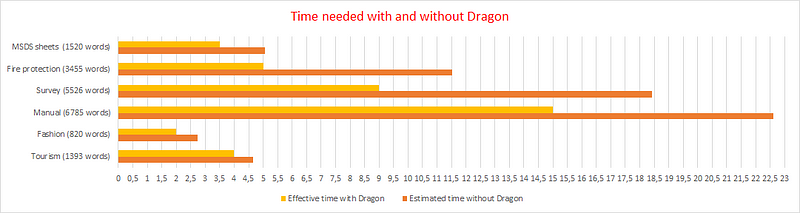
For those still wondering whether this investment is worth the money – because Dragon is quite pricey, after all – I have added a graph below of estimated times without Dragon and the times I actually needed with Dragon (from translation to final delivery). The times are expressed in half days.

By the way: if you work in Wordfast Classic, you will probably find it as easy as in MemoQ (or maybe even easier), because it is entirely based on Microsoft Word and so it should be completely compatible with Dragon.


Incidentally, a scientific article (*) has appeared on this subject – dictating translations – that identifies the benefits very clearly:

  • Dictation is up to six times faster.
  • A multimodal approach (combining dictation with your mouse and keyboard) is the most efficient method.
  • Dictating your translation is better for your concentration than typing in the text, and you do not get tired as quickly.
  • It improved the quality of some translators’ final translation because they had more time to spare (when working to a tight deadline) for research and thorough checking.
  • Translating as you dictate reduces your stress level and increases the number of words you can translate per minute.


I don’t entirely agree with that last point: in my experience it can also increase your stress level. Especially if you haven’t dictated your translations for a while and you start using Dragon again to pick up the pace. In that situation, it isn’t Dragon so much as pressure of time that increases stress.


(*) Source:  Traduire à haute voix (‘By Julián Zapata & Elizabeth C. Saint (University of Ottawa, Canada)


Combien coûte une traduction vers le néerlandais? D'où vient ce prix?
door Els Peleman 2 maart 2026
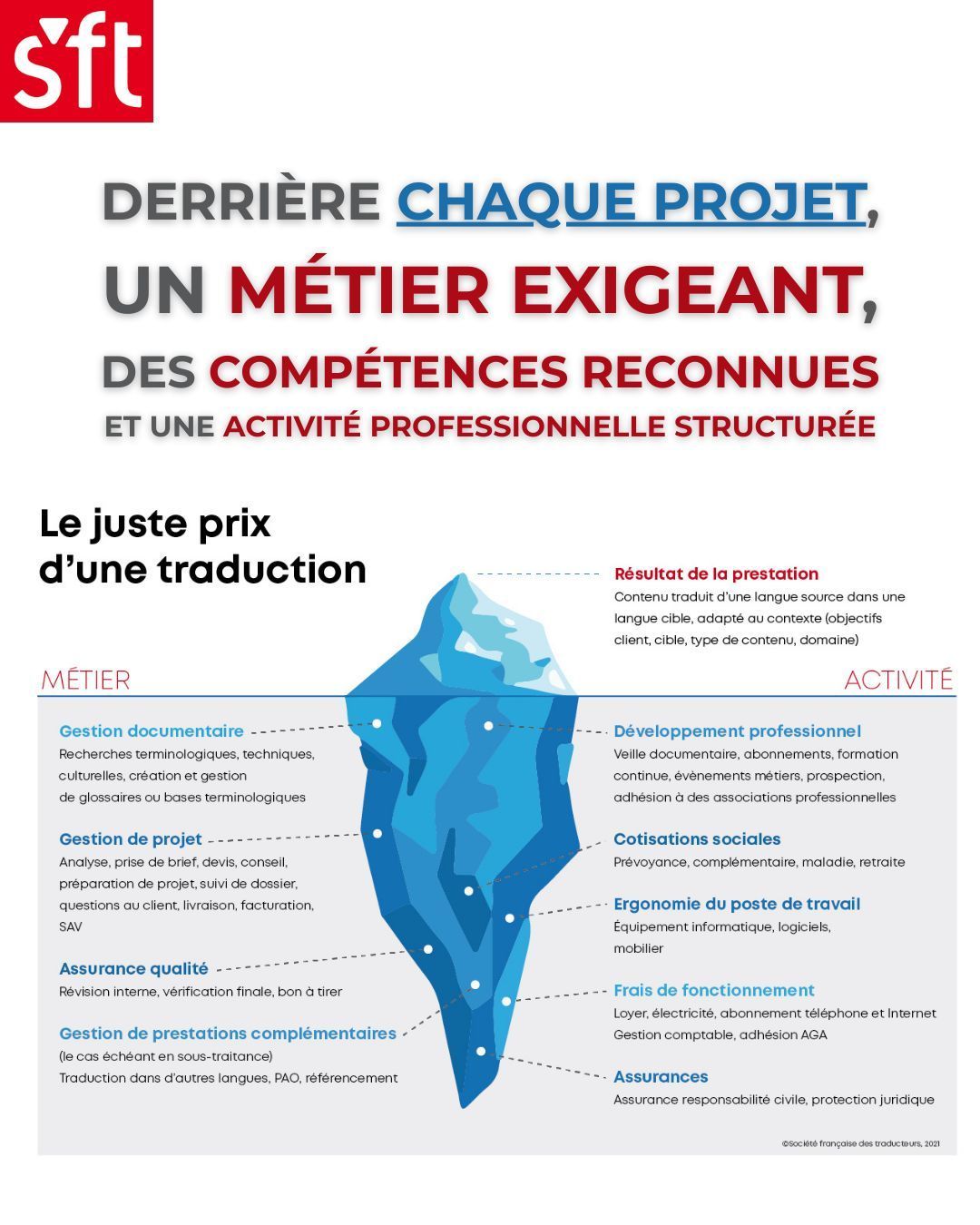
Combien coûte une traduction vers le néerlandais? D'où vient ce prix? Parce que derrière chaque projet se cachent bien plus que des mots.
door Els Peleman 2 maart 2026
I believe, I believe, I believe (Ik geloof, ik geloof, ik geloof) (translation of an extract from the Dutch song 'Avond', by Boudewijn De Groot) Last week on this platform, I shared my personal story about battling my demons , my anger at having to give up my dream job due to the dire economic situation, but especially because I felt that the outside world had absolutely no idea of what it means to be a (technical) translator. Wavering between my passion, my fighting spirit, a strong belief in my added value on the one hand and a negative spiral that is inexorably pulling me downwards – you cannot live on your conviction alone – and a battle that I cannot possibly win alone. My story quickly went around the world, and the expressions of support I received in return were overwhelming, not only on LinkedIn but also in my private life. Never before has one of my posts generated such a response. What started as “I need to get this off my chest” became something I can’t put into words, let alone translate. Initially shared out of a feeling of powerlessness and despair, my story somehow gave me some strength again. That’s just the way I am. I cannot and will not dwell on the glass half empty. But I also felt that I could not keep this new feeling, no matter how small, to myself, that I had to share that tiny spark of strength with the world – and especially my colleagues. Yes, of course, the reality is what is: a reality in which “ we don’t compete against AI but against the outside world’s perception that AI can do our work *,” but please let’s not give up! That’s why I hope I can convey some of my newfound strength to you. And entrepreneurs, teachers, outsiders, anyone faced with that choice, don’t believe everything that’s written. Put it to the test and see what gives you the most value: an AI translation or a text translated by a professional. (*translated quote and newspaper headline from the Flemish quality newspaper De Standaard). No, I am absolutely not against AI. Why should I? Without AI, my LinkedIn post would never have gone around the world so fast and I would never have received so many gestures of support. It’s true that AI allows you to read something written in a language you don’t understand. I use it too when I volunteer to teach Dutch to non-native speakers. But I’m never going to claim that AI can take over your job, so please don’t say that about mine either! As I said: “Of course, you can use AI to translate my post into your native language.” But don’t expect AI to convey my story, my despair, my passion with all their nuances. When it comes to deep understanding, especially in communicating emotions, AI fails miserably. For example, an Iranian refugee recently told me in Dutch about his traumatic experience with the Revolutionary Guards. I understood very well that what he was trying to say in Dutch – despite already having mastered the language quite well – was not even half of what he really wanted to say. That’s one of the first and all too common issues you face as a translator and for which you have to come up with a suitable solution: every language is built differently. While Arabic abounds with metaphors to describe mental and physical complaints, Inuit languages – never call them ‘Eskimos’, this is highly offensive to them – have countless words for snow and African dialects for cocoa, your terminology options in Dutch (and by extension almost all Western languages) are far more limited. That is also why I chose a snippet from a Dutch song that for me symbolizes rock-solid trust.
Ik ben er rotsvast van overtuigd dat ik, technisch vertaler, niet vervangbaar ben door AI.
door Els Peleman 2 maart 2026
Ik ben heilig overtuigd dat ik niet vervangbaar ben door AI. Ga de challenge met mij aan en bezorg mij jouw tekst en ik laat je zien waar ik het verschil maak.
Combien coûte une traduction?
door Els Peleman 2 maart 2026
« Votre offre de prix est deux fois plus chère que celle de votre collègue. Est-ce normal ? » « Oh là là, c’est bien cher. » Vous avez ce type de réactions lorsque vous envoyez des offres de prix ? Que répondez-vous à cela ?
Vertalen met ChatGPT. Een slim plan of toch beter vertrouwen op een professional?
door Els Peleman 14 januari 2026
“Met DeepL en ChatGPT gaat vertalen toch sneller? Waarom zie ik dat niet in de prijs?” Misschien omdat ik nadenk over elk woord en artificiële intelligentie niet?
Kan ChatGPT net zo goed vertalen als ik met mijn 25 jaar ervaring?
door Els Peleman 31 oktober 2025
Wat kan ik met mijn ervaring wat ChatGPT en Google Translate niet kunnen? Wat maakt het verschil tussen mijn ervaring als vertaler en een machinevertaling?
Meer posts