I believe, I believe, I believe
(Ik geloof, ik geloof, ik geloof)
(translation of an extract from the Dutch song 'Avond', by Boudewijn De Groot)
Last week on this platform, I shared my
personal story about battling my demons, my anger at having to give up my dream job due to the dire economic situation, but especially because I felt that the outside world had absolutely no idea of what it means to be a (technical) translator. Wavering between my passion, my fighting spirit, a strong belief in my added value on the one hand and a negative spiral that is inexorably pulling me downwards – you cannot live on your conviction alone – and a battle that I cannot possibly win alone.
My story quickly went around the world, and the expressions of support I received in return were overwhelming, not only on LinkedIn but also in my private life. Never before has one of my posts generated such a response.
What started as “I need to get this off my chest” became something I can’t put into words, let alone translate. Initially shared out of a feeling of powerlessness and despair, my story somehow gave me some strength again. That’s just the way I am. I cannot and will not dwell on the glass half empty.
But I also felt that I could not keep this new feeling, no matter how small, to myself, that I had to share that tiny spark of strength with the world – and especially my colleagues. Yes, of course, the reality is what is: a reality in which “we don’t compete against AI but against the outside world’s perception that AI can do our work*,” but please let’s not give up! That’s why I hope I can convey some of my newfound strength to you. And entrepreneurs, teachers, outsiders, anyone faced with that choice, don’t believe everything that’s written. Put it to the test and see what gives you the most value: an AI translation or a text translated by a professional.
(*translated quote and newspaper headline from the Flemish quality newspaper De Standaard).
No, I am absolutely not against AI.
Why should I? Without AI, my
LinkedIn post would never have gone around the world so fast and I would never have received so many gestures of support. It’s true that AI allows you to read something written in a language you don’t understand. I use it too when I volunteer to teach Dutch to non-native speakers.
But I’m never going to claim that AI can take over your job, so please don’t say that about mine either!
As I said: “Of course, you can use AI to translate my post into your native language.” But don’t expect AI to convey my story, my despair, my passion with all their nuances. When it comes to deep understanding, especially in communicating emotions, AI fails miserably.
For example, an Iranian refugee recently told me in Dutch about his traumatic experience with the Revolutionary Guards. I understood very well that what he was trying to say in Dutch – despite already having mastered the language quite well – was not even half of what he really wanted to say.
That’s one of the first and all too common issues you face as a translator and for which you have to come up with a suitable solution: every language is built differently. While Arabic abounds with metaphors to describe mental and physical complaints, Inuit languages – never call them ‘Eskimos’, this is highly offensive to them – have countless words for snow and African dialects for cocoa, your terminology options in Dutch (and by extension almost all Western languages) are far more limited.
That is also why I chose a snippet from a Dutch song that for me symbolizes rock-solid trust.
I see the fire of hope and doubt in your eyes
And I know your deepest fear
You can’t know anything for certain, and everything ends
But I believe, I believe, I believe,
I believe, I believe in you and me.
By the way, if you want to hear the doubt and despair, but also the trust, as I hear it, listen to the
cover by Jaap Reesema, because that’s the version that spontaneously came to my mind after all the reactions of the past few days. But try to translate that feeling, the emotion I get from listening to this song... that’s the challenge!
It’s precisely because I will never rely on AI to understand something in all its nuances that I also felt the need to have this second article,
a message of hope and (resilient) strength, translated into English.
Not just because I want to give my colleagues who speak another language the opportunity to use this article in any way. Rather and primarily because I want to make non-Dutch-speaking entrepreneurs, and certainly also teachers, aware of the totally false perception of AI and translation.
So, fellow non-Dutch-speaking translators, please seize your opportunity and let’s not sink into despair!
That’s why I asked my good colleague
Claire Weston to translate this second post into English for me. Precisely because her life story, marked by perseverance and a belief that “in the end everything will be fine”, fits perfectly with the message that I want to convey here, despite the harsh reality. This brings me directly to another point that many people underestimate considerably:
every translator is different.
It’s not just that my English is absolutely not good enough for this, even if I were to translate from English, I wouldn’t dare. Why?
Because you don’t master any language as well as your native language (or second language). A very good example is
Vincent Kompany’s press conference about the racist incident with Vinicius Jr. In this instance, Vincent Kompany wanted to be able to express himself correctly on such a sensitive topic, but his German was inadequate for that.
But feel free to translate this article into your native language with AI if your English isn’t good enough. As long as it is for personal use and
you realize that AI is not a flesh and bone human who can think and feel.
As I said: “It is what it is. We cannot make AI disappear and we don’t have to.” But let’s use it wisely. Not to replace people who are irreplaceable. Not to bring about Elon Musk’s vision of the future: “AI and robots will replace all jobs. Working will be optional, like growing your own vegetables, instead of buying them from the store.”
Now, all joking aside: is that what we want? If we were to take this discussion to a philosophical level, what would be the meaning of existence then? Sure, more free time is great. But no longer have to work at all?
To be honest, I don’t see this happening either. Of course, AI will change certain tasks and professions, but will it replace them completely? No, I don’t believe that scenario. So no, I don’t see AI taking over my job, not a translator’s job in general, and certainly not that of a technical translator.
If I weren’t convinced of that,
I would have pulled the plug long ago.
I am that realistic.
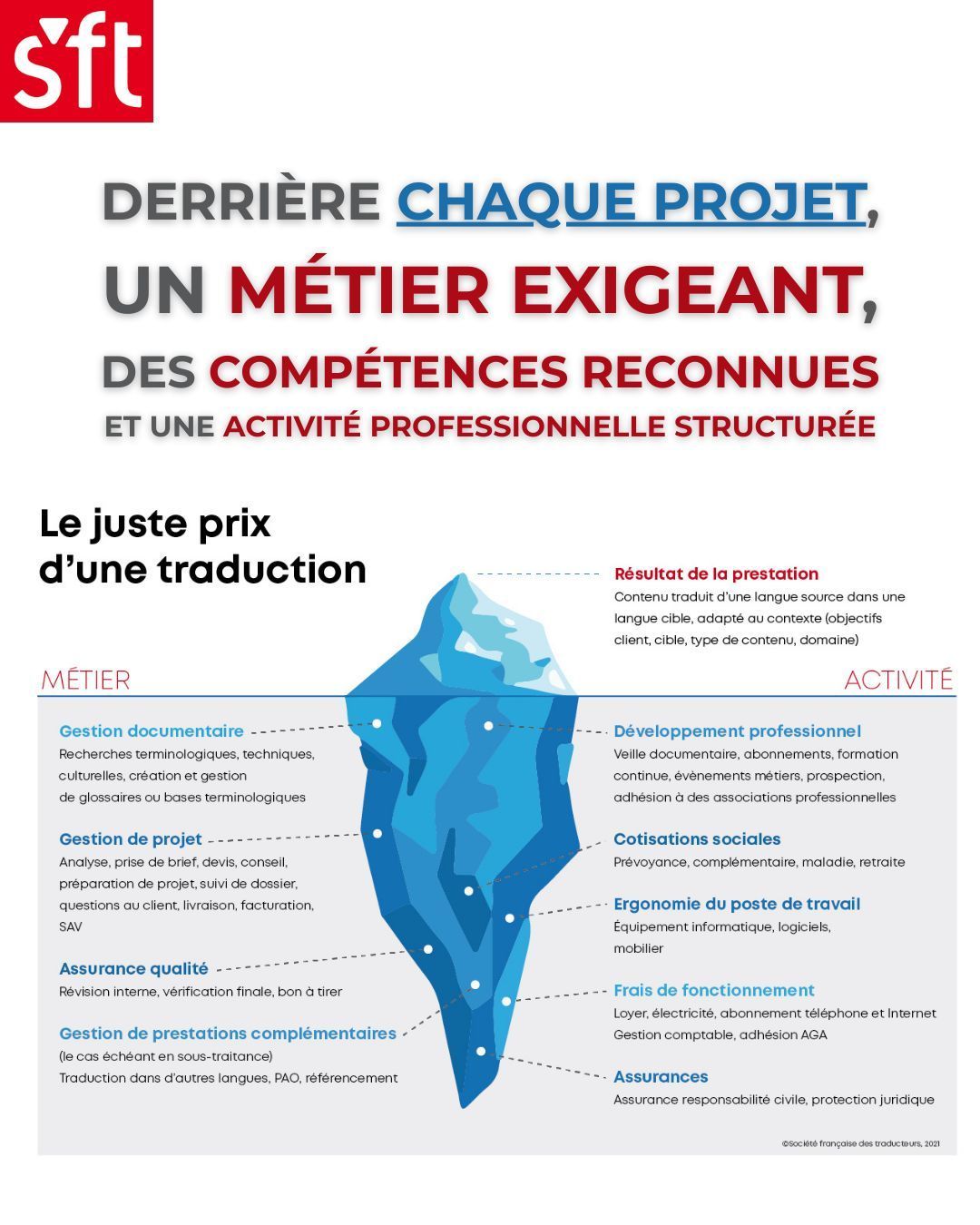
Translation is so much more than what people outside the profession may think.
There’s so much to it that I don’t even know where to begin when someone asks me (and precisely because there’s so much to it, it can’t be captured in prompts, no matter what they say). Every translation project, even if it is for the same client, is different and requires a different approach.
And while countless things differentiate me from AI, I can’t just produce those arguments at will as they are different every time. Besides, when you’re put on the defensive, the best examples often don’t immediately come to mind. However, I always have one example at hand, and it’s one that never ceases to amaze me: a translator will always check the client’s website first;
AI can’t do that. It can’t be that hard to teach AI that, wouldn’t you think? If an AI tool could do that for me, that would certainly save me a lot of time, but no. So much for intelligence.
And yes, I can see the signs that the AI bubble is about to burst: over the past few days I’ve heard quite a few stories about people waking up with the ‘AI hangover’, who realized that AI is not as good as was claimed, who even developed a real aversion to it. So, there’s hope.
But will the tide turn in time? No matter how much I believe it will happen, that belief won’t put food on the table. In addition, spending your days idle, not doing what you love most, even if you know that good years will eventually return after the lean years, is really horrible. All that time alone with your dark thoughts, going totally crazy.
And your piggy bank cannot last forever either. What if it takes way too long for the world to realize that AI cannot replace translators? What if there are no translators left by then? Is the world doomed to deal with AI’s (lower) quality and all the negative consequences attached to it (fake news, hallucinations, polarization, disappearance of inclusivity, gender diversity, ...)? Sure, it’s a worst-case scenario, but it is the one that’s keeping me awake at night. After the covid-19 pandemic, many translators were already at their wits’ end, and now that this AI bubble is added to the mix, it feels like the last straw for many. I see with dismay how many long-standing colleagues are forced to throw in the towel, simply because they have no other choice. The future generation of translators is also in a particularly bad situation… The number of students in language courses has dropped dramatically.
I can’t imagine that there will be no one left to translate everything correctly, ensuring product safety, completeness... as it should be.
Now it’s up to you.
If you have compelling, and above all, useful examples
that an outsider can understand without too much effort, please share them below in English or your native language.
Who knows, if we join forces, maybe we can poke that AI bubble a little more with a toothpick.
And
if you are looking for someone to carry out technical translation work
(for example, a newsletter, a technical data sheet for a new product, a manual for a new machine that you are going to import or export, an online store in urgent need of a rework after the DeepL translation didn’t deliver on its promises, etc.), feel free to email me. I’d be happy to provide you with a quote and
explain in detail why my expertise can add value to your situation. If I can use a concrete example, I can pull convincing arguments out of my hat. I have plenty of clients who, just like you, had to struggle before they saw the light and realized that an experienced professional translator is of a different caliber than ChatGPT and the likes.
Translated by my colleague Claire Weston: if you need translation work into English, she has you covered! I give you my word! You can contact her, by clicking on this link!